Bank of Russia to increase financial inclusion of disabled people
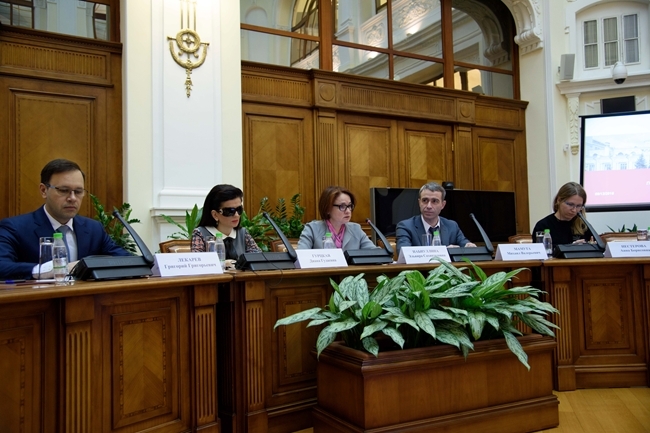
Financial services and instruments will become more accessible for handicapped people. This will require both technical solutions, including information technologies allowing to overcome the barriers, and amendments to applicable legislation and regulations. On 9 December 2016, the Bank of Russia hosted a meeting with representatives of the authorities, financial market participants and public associations of disabled people. A working group to improve the financial inclusion of disabled people set up in the course of the meeting is to develop these measures.
‘I am sure that we should work to remove the barriers which arise when disabled people apply for financial services. Virtually, unadapted financial institutions rather than disabilities put obstacles in people’s way to obtain financial services’, Elvira Nabiullina, Bank of Russia Governor, noted in her speech. ‘There are a few cases when financial institutions pay attention to these issues, since financial inclusion leaves much to be desired. We believe that the situation should change under the influence of regulatory measures, more exigent requirements for market players to ensure accessible environment. We will closely monitor the financial institutions’ compliance with these requirements’.
‘The accessibility of financial instruments is more important and wider than the accessibility of premises of banks and financial institutions’, Diana Gurtskaya, a member of the Public Chamber, said. ‘We should build a system of mutual trust between disabled people and the financial sector. Public associations of disabled people can render their support’.
Grigory Lekarev, Deputy Minister of Labour and Social Protection of the Russian Federation, shared the Bank of Russia’s initiative to set up a special working group and expounded on changes in the Russian legislation related to Russia’s ratification of the UN Convention on the Rights of Persons with Disabilities. Certain changes are already in effect, other will become effective in January 2017. Work will begin to compile a Federal Register of Disabled People, which will help the authorities to establish cooperation with every person with disability.
The working group will comprise representatives of the Bank of Russia, experts with various forms of disability (representatives of public organisations and associations of disabled people), representatives of market participants’ associations, and also, if required, representatives of the Ministry of Labour and Social Protection of the Russian Federation, Presidential Commission for the Disabled, and the Public Council for the Disabled under the Council of the Federation.
The working group will focus on the exposure of barriers hindering the disabled people from obtaining full-fledged financial services, as well as summary and systematisation of successful programmes to overcome these barriers in various financial organisations.
The working group is to develop a road map containing a set of specific measures to increase financial inclusion of persons with disabilities. The priorities include using the remote financial services, including biometric methods of identification and authentication; development of standards and/or recommendations for financial organisations with an accent on expanding cooperation with the disabled consumers. Moreover, plans are afoot to develop a methodology for new services or adapting the existing ones to make it easier for disable persons to handle bank cards, including NPCS cards.
Changes will also be made on the Bank of Russia website for people with poor eyesight.
The meeting to set up the working group was attended by representatives of the Ministry of Labour and Social Protection of the Russian Federation, Russian Ministry of Finance, Ministry of Industry and Trade, the Council of the Federation of the Federal Assembly of the Russian Federation, the Association of Russian Banks, the All-Russian Union of Insurers, NPCS JSC, the All-Russian Association of the Disabled, the All-Russian Association of the Blind, the All-Russian Association of the Deaf, the Regional Public Association of the Disabled Perspektiva, other public associations of people with disabilities, and also credit institutions.