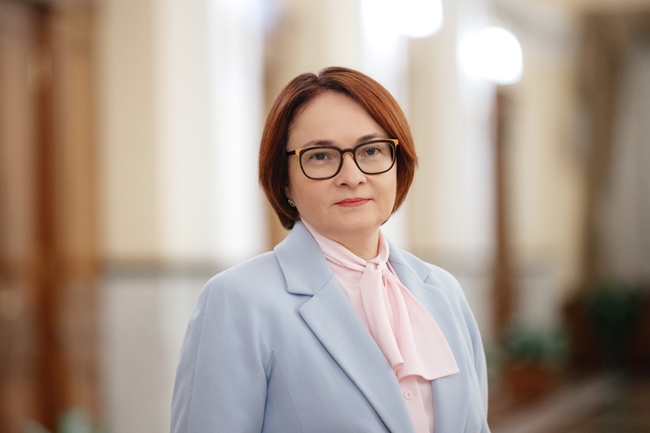
Elvira Nabiullina’s speech at meeting on banking issues chaired by State Duma Speaker Vyacheslav Volodin
Dear Mr Volodin, dear colleagues,
In my opening address, I would like to speak on the current state of the banking system, its capability to deal with challenges, and first and foremost, on the progress of the measures to support people and business in today’s situation.
As Mr Volodin has said, the situation is really unprecedented.
We should do our best to mitigate the shock for the economy and, which is just as important, to ensure a fast recovery of the economy after the restrictions are eased or cancelled.
As you know, last Friday we made the decision to reduce the key rate to 5.5% per annum. We have also switched to accommodative monetary policy.
It is vital for the economy to receive support, including relatively low-cost funds, primarily after the ‘unfreezing’. This is why we are focusing on the fact that we do have room for a further key rate decrease. Being aware of the nature and the scale of the economic shock we are now facing, we are stating that the key rate may be cut in larger increments than before.
Now, on the situation in the banking sector.
How does the current situation differ from past crises? By the moment, banks have achieved quite a good standing and earned sufficient capital and liquidity to maintain their sustainability and continue lending. In other words, today’s crisis begins not from banks. On the contrary, banks are now capable to support the economy, reasonably using the resistance potential they have accumulated.
Analysing the figures for the twenty days of April, we can state that the adverse impact of the pandemic has changed banking statistics, including the data on lending, only slightly by now. Of course, we understand that the situation will definitely be changing and lending growth rates may be expected to be low this year.
Both households and businesses are certainly very careful today about increasing their debt burden when uncertainty is so high. Direct aid is more important for them. In turn, banks have also become more careful granting new loans since it is difficult in the current situation to estimate borrowers’ creditworthiness in the future.
Unsecured consumer lending will also be declining, and, in our opinion, the decrease in this segment may reach minus 5%. I would like to remind you that last year the growth in unsecured lending totalled 21%. The situation in mortgage lending will be improving owing to the support measures announced by President Putin and being implemented by the Government. These measures provide for the subsidising of the interest rate at the level of 6.5%. Last year, the mortgage segment was growing at a high pace of approximately 20%. We forecast that this year mortgage lending will increase by 10%. Nonetheless, this is a rise. According to our estimates, the corporate loan portfolio will slightly expand, but this will be primarily driven by the fact that large companies are addressing the Russian banking system, exiting foreign markets and the bond market. What actions are being taken on our part? We have introduced a range of regulatory relaxations and cancelled a number of buffers so as to support lending.
Unfortunately, overdue and non-performing loans are expected to increase. A large amount of loans will be restructured both within the loan repayment holidays provided by law and based on President Putin’s proposals and under banks’ in-house programmes. Today, individuals whose incomes have materially declined (according to our assessment, this is over one half of bank borrowers), the majority of small and medium-sized enterprises (SME), and companies of the most affected industries are the most vulnerable borrowers. According to preliminary estimates, these groups of borrowers collectively account for approximately 19 trillion rubles, or about one third of the total loan portfolio. This is quite a large figure.
We have entitled banks not to increase temporarily their loss provisions for a very broad range of loans since we expect that a large portion of borrowers will resume normal servicing of their debt. As to loans that will become non-performing even despite the restructuring, banks will be forming loss provisions for them gradually.
We expect that lending rates will be stabilising. On the one hand, banks’ credit risks have certainly increased, but on the other hand, demand for borrowing will probably be subdued, limiting the growth of interest rates. Moreover, as I have already said, we cut the key rate, enabling banks to raise lower-cost funds. However, interests rates may somewhat grow for a range of borrowers, given the rise in credit risks.
We do not expect that the banking sector will be experiencing any hardships with funding, even with account for a slight reduction in retail deposits in the future.
I would like to emphasise that the banking system in general currently has a surplus of liquidity of nearly 2 trillion rubles. The distribution of this liquidity across the banking system is certainly uneven, which is why we are carrying out our operations to smooth out this unevenness.
We can also see that there may be a disbalance in terms of maturities between banks’ assets and liabilities. In order to address this situation, we are expanding the Lombard List and are going to launch long-term repos for banks to have opportunities to raise long-term funds from the Bank of Russia.
We also do not expect that there will be a considerable deficit of capital since banks have accumulated sufficient capital cushions by the moment of the current situation. However, this capital is also unevenly distributed across the banking system. Moreover, we cannot clearly understand the intensity of the stress. Therefore, banks should be addressing the situation more responsibly and limit their bonus and dividend payouts, as we recommended them earlier, in order to maintain their safety cushions and use them exactly to ease the situation for borrowers and continue lending.
I would like to remind you of the measures we have been implementing to support households and businesses.
In addition to the regulatory easing I have already mentioned, we also launched the preferential 4% refinancing programme for SME loans with the limit of 500 billion rubles. Moreover, on Friday we cut the interest rate for this facility from 4% to 3.5%. In other words, the key rate is now 5.5%, while the interest rate within this programme is 3.5%. A portion of this limit (150 billion rubles) has been reserved for loans intended to pay salaries at the zero interest rate, that is, to support the governmental wage programme.
As regards loan restructuring, the main issue here both individuals and SMEs are complaining about is that it is not always possible to restructure their loans.
I have already stressed that banks are now facing an unprecedented flood of loan restructuring requests. Over less than a month, the number of restructuring applications received by some banks has several times exceeded the overall number for the entire last year. Therefore, banks should also be adjusting their business processes, which they are already doing now, and should consider restructuring requests faster, without declining them groundlessly.
Together with the Government, the Bank of Russia continues the monitoring of this situation on a weekly basis. At the moment, this task is being tackled by our Service for Consumer Protection and Call Centre in order to track possible irregularities. The data on loan restructuring are given on the slides we sent you in advance. We provide this information to you weekly in our Financial Pulse review. It contains all statistics on individuals’ mortgage, consumer and car loans, and on SME loans. Overall, we can see that the situation is improving, with the percentage of approvals growing. Of course, we will be closely monitoring the progress of loan restructuring and communicating with banks in order to simplify the restructuring procedure for clients since we understand that this is essential for people.
Another critical issue amid the restrictions in place is to switch banks to remote work with clients to the maximum extent possible.
For this reason, we have eased our client identification requirements for a range of operations, including social payments and mortgage lending, for individuals to reduce their visits to bank offices.
We believe that it is necessary to further develop remote channels.
We need your support in this area in order to enhance digital finance and remote services in Russia. There are draft laws that are under discussion in the State Duma. Today’s situation proves this to be critical. It is good that we have approached this period with sufficiently well-developed digital finance capabilities, in contrast to many other countries, but this area needs further advancement.
I would also like to speak on several issues where we need the support of the State Duma.
Firstly, it is essential to expand the range of operations available through biometrics and to adopt laws enabling the advancement of remote services.
In our opinion, we also need amendments to the law on OSAGO (compulsory motor third-party liability insurance) that would permit purchases of OSAGO policies without technical inspections. We have given the related recommendations to insurers, but we definitely need legislative changes.
We can see that the numbers of attempted cyber frauds and deceptions have risen amid the restrictions in place, for instance, swindlers are offering fake restructuring to individuals. We are urging the State Duma to speed up the approval of the draft law on blocking fraudulent websites in the financial area. It was submitted for consideration back in 2018, but its second reading has not yet started.
Another measure we have approved to support banks for them, in turn, to be able to support their borrowers is the reduction of banks’ contributions to the deposit insurance system. However, this decrease will unfortunately become effective only in 45 days pursuant to law. We would like to ask the State Duma to introduce necessary amendments so that this relaxation may be used by banks immediately and even cover previous periods.
I also believe that it would be appropriate now to expand the deposit insurance system. These are the issues we have been discussing for a long period of time. Specifically, it should embrace the accounts of socially important non-profit organisations and the overhaul accounts of housing owners associations, and in a number of cases provide for increased social payments of up to 10 million rubles. We have also discussed such cases. I believe that this would also be vital in today’s conditions.
Winding up, I would like to emphasise that we are aware that individuals and businesses are now suffering the adverse consequences of the pandemic. Banks are actually helping to absorb economic losses through loan restructuring. The measures being implemented by the Bank of Russia and the Government also enable borrowers to raise new loans, primarily for urgent needs. However, it is important to understand that this is affecting banks because they have to accept a part of losses. I have already said that banks do have safety cushions which they can use, but it is critical to strike a balance here. The hazard in this regard is that the banking system itself may be facing higher risks or banks will become unable to expand lending if banks’ burden to support borrowers continues to increase. If banks become incapable to build up lending when the epidemic starts to wane, this will delay economic recovery. Therefore, we believe that it is crucial at this stage to expand the governmental programmes of direct aid to people and business in order to avoid such developments.
Thank you very much for your attention. If you have any questions, I would be glad to give my comments.