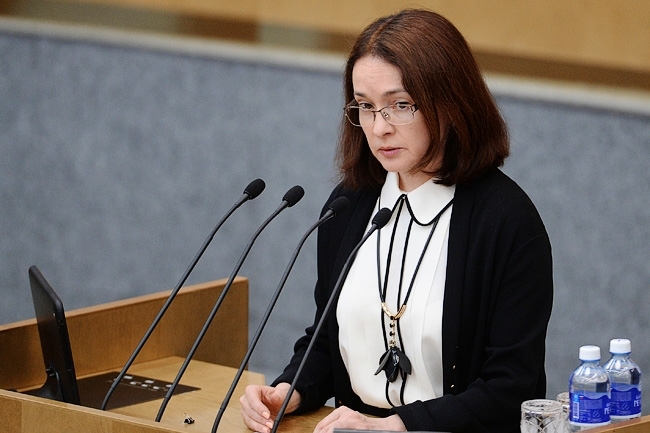
Bank of Russia Governor Elvira Nabiullina presents Guidelines for the Single State Monetary Policy in 2016 and for 2017 and 2018 at State Duma Plenary Meeting
Good afternoon, Mr. Naryshkin and esteemed deputies of the State Duma!
First of all, I would like to thank the deputies for their profound and thorough participation in the work over the Monetary Policy Guidelines. As a result of our discussions with the Working Group and the committees the document was specified and amended. The Bank of Russia Board of Directors approved the amended document on Tuesday.
I am going to start with the general characteristics of the current situation and main risks posed by this situation. These are the pre-requisites for our monetary policy implementation. Then I will provide an overview of the forecast and our major monetary policy instruments.
Current situation
The ongoing global uncertainty continues affecting the Russian economy. A fall in oil prices, a slowdown of economic growth in China, and normalisation of the US Fed’s monetary policy come to the fore in terms of external risks.
The oil market transition to a new equilibrium with a lower price level has and will continue to have an adverse impact on the Russian economy. The fall in oil prices together with the limited access of Russian banks and companies to external borrowing result in the reduction of foreign currency earnings by an estimated $200 billion in annual terms.
China does not expect the situation to change dramatically. However, certain risks relate not only to decreased growth rates, but also to the changed structure of economic growth in China. Chinese industry whose growth influences demand for commodities witnesses a faster decrease than the entire economy with the services sector starting to play an ever greater role.
As far as the Fed’s policy is concerned, the focus shifts from a specific date to raise the federal funds rate to a longer-term policy horizon, i.e., the pace of rate raising. The discrepancy between market expectations and the actual Fed’s policy to raise rates may entail risks of capital outflow from the emerging markets (including Russia) and elevated volatility both this year and next year at least. We are taking account of these risks in our policy.
The ruble exchange rate, unfortunately, continues to be highly volatile under the impact of external negative factors. However, it has moderated slightly since the start of the year and does not pose any serious risk to financial stability. Moreover, its influence on inflation and inflation expectations and consequently on economic agents’ behaviour diminishes.
External conditions remain unfavourable, but our economy is gradually adapting to them.
Inflation is on decline. An inflation surge late last year – early this year was caused by powerful yet one-off factors: the drop in oil prices and subsequent depreciation of the ruble. Their effect has already materialised. Inflation is slowing down, we expect it to fall to 12%-13% at the year end. According to our forecast, inflation will continue its downward trend next year, facilitated by moderately tight monetary policy as well as restrained fiscal policy and low demand. We forecast inflation to stand at 5.5%-6.5% by late 2016. The monetary policy guidelines provide for three forecast scenarios: baseline, optimistic and pessimistic ones. All of them envisage reaching the 4% inflation target by late 2017. I would like to note that while deciding on the monetary policy, we always imply the balance of inflation risks and economic growth risks. The inflation target cannot be reached to the detriment of economic growth.
We expect returning to the positive growth rates by the second half of 2016, while in 2015 the slump will be equal to an estimated 3.9%-4.4%. Capital outflow this year will stand at about $70 billion, we have downgraded the forecast here (previously we expected $85 billion).
The transition to the floating exchange rate played a major role in the economy’s adjustment to the new external conditions. The floating exchange rate is not the only yet significant factor which has accelerated adaptation of the balance of payments and changes in the economic structure in response to external shocks. As far as the balance of payments is concerned, we are simultaneously witnessing growth in the current account balance and reduction in capital outflow due to the reasons not pertaining to debt payments. Along with the balance of payments adaptation, we also see the signals of the changed economic structure, the first signs that the situation is turning out to be more stable in the exporting and import-substituting sectors.
A few words about the situation in the banking sector.
I will start with the situation in the deposit market. This year we have managed to overcome the situation of the last year when we observed a decline in ruble deposits.
In the first ten months of 2015, deposits grew by 14.2% (without taking account of the foreign currency revaluation by 10.2%).
Now, as far as lending is concerned. Early this year, lending has actually hampered and continued to dwindle in certain sectors, for example, in small business sector. However, growth in lending has resumed over the past few months.
Over the first ten months of 2015, banks increased corporate lending by 7.1% (without taking account of the foreign currency revaluation by 2.2%).
I would like to note that lending grows despite the fact that the quality of bank lending portfolio has deteriorated. It is true we see some positive shifts in this sphere as well. Overdue debts increase, but this trend is fading out. Thus, in October 2015 the share of overdue loans to non-financial organisations grew by 0.1% to 5.9%, and the share of overdue retail loans grew from 8.0% to 8.1%.
Nevertheless, growth in lending can be restricted not only by high interest rates, but also by a rather high debt burden accumulated by the non-financial sector as a whole. The total debt burden of enterprises, including both external loans and bonded loans, currently amounts to about 80% of GDP. Though it is below the level of developed countries, it is still higher than in many emerging markets. There are sectors and companies having a potential of building up lending and there are also those whose further debt growth is contraindicated, their debt burden is high enough and may pose a threat to their development. High risks are observed in the construction sector, in certain companies of the manufacturing industries, and in the coal industry. Financing real sector growth is largely an issue of restoring companies’ solvency and raising capital rather than an issue of building up loans. Based on other countries’ experience, we see that excessive lending expansion may entail great risks for future development.
Let me turn to our forecast.
Earlier, we have already presented our forecast, so I will dwell on it in brief.
We single out three forecast scenarios depending on oil prices. In the baseline scenario, the average annual price is $50 per barrel, the optimistic scenario assumes an increase in oil prices to $70-80 per barrel, whereas in the risk scenario average annual oil prices do not exceed $40 per barrel.
The main assumption behind all the scenarios is that financial sanctions and trade restrictions will persist in the coming three years.
The baseline scenario forecasts that annual economic growth rates will turn positive in 2017 to reach 2.0%-3.0% in 2018.
Under the baseline scenario, as inflation slows down and inflation expectations stabilise, we will be able to continue cutting the key rate.
The optimistic scenario provides for the economic growth recovery (in annual terms) already in 2016. Inflation will decline gradually, as under the baseline scenario. Therefore, the evolving situation will be more conducive to both decreasing the key rate and building up international reserves.
Amid elevated uncertainty with regard to oil market outlook and also to global economy in general, it is essential to stay prepared to the most unfavourable developments. For this purpose, we have considered a risk scenario. Should risks escalate, we will be ready to employ the whole range of instruments and measures, including through expansion of FX refinancing operations and foreign currency sales to maintain financial stability. These instruments are ready for use in case of need.
Now, let me say a few words about refinancing instruments. I would like to remind you that in addition to regular instruments, we have introduced special-purpose ones. These are aimed at supporting lending to high-priority sectors of the economy and at closing market gaps whenever they occur.
First, about the development of regular instruments.
In the second half of 2014 and early this year, we have been focused on the collateral shortages caused by the surge in demand for ruble liquidity provided by the Central Bank and the restricted access to the foreign currency liquidity.
To resolve the collateral issues we have expanded the Lombard List, the Bank of Russia List of Guarantor Entities, and raised adjustment ratios used to assess the cost of assets eligible as collateral. We have also elaborated lending facilities to provide foreign currency liquidity.
But, in the first half of the year, the situation with the ruble and foreign currency liquidity improved markedly. Banks’ deposit base began to grow. This eliminated the acute demand for Central Bank operations, and we were able to reduce their volume. Over the period from the start of this year up to the present moment, outstanding amounts on ruble repos have dropped from 2.8 trillion rubles to 789 billion rubles, and on Bank of Russia secured loans they have decreased twofold: from 4.4 trillion rubles to 2.2 trillion rubles.
Foreign currency facilities (repos and loans) introduced last year helped improve the situation with foreign currency liquidity and smooth out peak payments of external debt, thus stabilising the foreign exchange market. Starting the second quarter, the FX liquidity situation has levelled out, and the demand for Bank of Russia operations has been subsiding. As a result, the amount of funds drawn on all foreign currency instruments has fallen from the maximum of $36 billion to roughly $26.5 billion. The Bank of Russia set the limit of $50 billion on these operations.
It should be noted, that the foreign currency liquidity provision facilities are not limited by 2015, repos have been introduced until end-2016, and foreign currency loans – through end-2017. The Bank of Russia is monitoring the sufficiency of non-financial organisations’ and banks’ foreign currency liquidity for servicing their external debts. According to our 2016 estimate, next year external debt payments will be well-balanced. Moreover, we are conducting special surveys of Russia’s largest companies. Answers of top 30 companies show that, in the first quarter of 2016, the external debt payments (I would like to emphasise that these are inclusive of existing intragroup financing) will total $6 billion, and in the fourth quarter this year, they will stand at $8 billion (once again, inclusive of intragroup payments). In 2016, corporate external debt payments will be twice as low as in 2015. Overall, the Russian external debt has declined markedly compared with 2014, almost by 30%. As of early 2014, the external debt totalled $729 billion, and now it stands at $522 billion.
Let’s turn to special-purpose instruments.
We have four of them and they are intended to support lending to small and medium-sized enterprises (6.5% interest rate, 3 year maturity), non-commodity exports, project financing (the interest rate for these two instruments is 9%) and military mortgage.
As of today, we have spent 43.7 billion rubles out of 100 billion rubles to support investment projects, 32.8 billion rubles out of 50 billion rubles on lending to SMEs, and 17.2 billion rubles out of 50 billion rubles on loans to non-commodity exporters. This year, the 10-billion-ruble limit provided under the Military Mortgage programme has been increased to 30 billion rubles and at the moment a bit less than 20 billion rubles have been used.
We are often asked to expand the limits on these special-purpose instruments. I agree that sometimes it makes sense when the existing limits are run out. Thus, this year, we have expanded military mortgage refinancing limit as I have mentioned and increased project financing from 50 to 100 billion rubles. But sustainable economic growth and economy diversification require regular access to funding for a wide range of economic agents rather than only those capable of applying to the government to obtain a special-purpose loan. Therefore, we have to stick to the policy that will result in lower interest rates on all loans rather than expand lending at reduced rates to the privileged borrowers, thereby slowing and reducing rate cuts for all loans.
In conclusion, I would like to say that, as you can see, we try to be flexible in our response, adjust our instruments, and introduce new measures to provide necessary support. We seek to quickly respond to any developments in the external conditions. The first nine months of this year have proven these measures to be efficient. But at the same time we do not allow to distort monetary policy mechanisms, avoid excessive easing in the banking sector which would disguise problems rather than solve them. Our goal is not to disguise economic challenges, but to give banks and the real sector time to adjust to the new environment.
Amid high global volatility – that is likely to persist – the main objective of the central bank is to ensure price stability, financial stability and overall economic stability. Strong shocks make it hard to achieve all these goals simultaneously. Last year, when we decided to move to the floating exchange rate in tough conditions, we had to allow inflation to surge to mitigate economic risks. However, we have managed to curb inflation rather quickly and we stick to the policy that will reduce inflation. At the same time, we have taken measures to sustain financial stability. Our goal for the period ahead is to prevent inflation that has increased earlier this year from threatening future economic growth. Long-term interest rates for economic agents are especially important. They will go down only if inflation and inflation expectations decline. It is important for us to anchor this downward trend in long-term interest rates. Today, when deciding on interest rates, we have to look at both current and prospective economic growth and inflation risks. If we cut the key rate too fast, we may risk to face higher rates in the future. We should not allow it to happen.
When taking our policy decisions we have been and will be guided by the fact that financing depends on the mutual trust between market participants, their confidence that the Central Bank is capable of ensuring price and financial stability, their confidence in the future, more than on the value of short-term funding from the Central Bank.
That would be the end of my statement. Thank you for your attention.