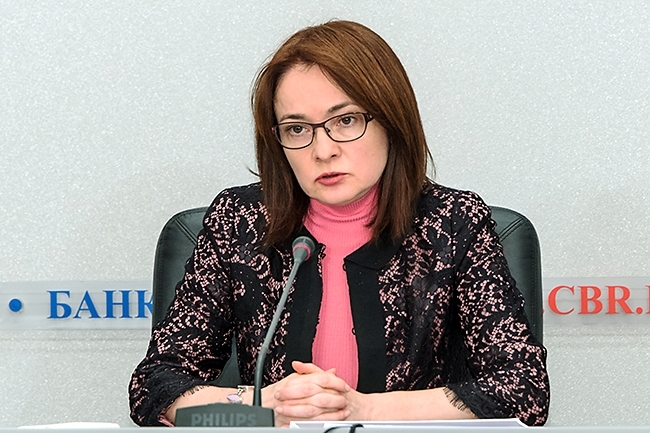
Bank of Russia Governor speaks at the RF Finance Ministry board meeting
Good afternoon, dear colleagues.
Admittedly, macroeconomic stability is our top priority, absolutely crucial. Yet, the current conditions, which we recognise as new normality, do call on us to have a positive impact agenda to establish conditions for economic growth.
This positive impact agenda should address, among other industries, our financial market. In this field, the Government, the Finance Ministry and the Central Bank, a megaregulator, do share a multitude of tasks, and I welcome today’s discussion.
When we speak on the positive impact programme, it is important to note that this agenda, this structural transformation programme should be based on, not compromise, macroeconomic stability.
The present environment is challenging to both fiscal and monetary policies. This challenge is to maintain macroeconomic stability as the commodity price environment for Russian exports is deteriorating sharply.
What is macroeconomic stability? Macroeconomic stability means low deficit, low debt and low inflation. These three, being structural change enablers, would engineer economic growth in the future.
How much we are capable of keeping macroeconomic stability in adverse conditions, is, to a great extent, our maturity test. In a sense, it is a test to show whether we are capable of making hard yet right decisions in a challenging setup. These decisions would make sure that our businesses and citizens remain confident in our policy, in the fiscal policy.
I must say that the Finance Ministry has been following this principle in the recent years, which resulted in the appearance of the so-called safety cushion, made up of the Reserve Fund and the National Wealth Fund. It is crucial that we preserve these accomplishments.
I do realise that we are faced up with the real dual challenge of keeping budget deficit in check, on the one hand, and ensuring, on the other, that the budget expenditure structure remain optimal. This budget cost optimisation should then be governed by the need to prioritise the costs which engineer economic growth.
Admittedly, monetary and fiscal policies are interrelated. In a scenario of unbalanced budget and unchecked growth of public debt, long-term interest rates and inflation expectations will grow. It would be harder for the Central Bank to keep inflation in check; the private investment climate would also suffer. Even were the drivers and fundamental indicators to remain unchanged, the foreign exchange rate would come under stronger pressure.
Now then, I would like to say a few words about the forex market situation. Since early this year, we have seen a surge in global markets volatility, with a stronger volatility of the Russian market. We at the Bank of Russia are closely watching these developments. We are monitoring indicators for both registered and expected volatilities. We seek to keep them from excessive growth, such as brought about by factors other than fundamentals, that is, factors related to forex liquidity and other market disruptions. And we have the complete set of tools to act proactively and prevent threats to financial stability from materialising.
Certainly, everyone is interested in what happens next. The global and Russian market volatilities stem from investor concerns about the situation in China, as well as the volatility of oil prices. The oil market situation is a key factor for our economy. And Anton Germanovich [Siluanov] is right here: a rebound in oil prices is not impossible, but the prices should not be expected to return to the high level of the past few years.
In a positive development, however, the share of oil in the Russian commodity exports has fallen from 67% for December 2013 to 48% in December 2015. The reliance of the economy and the exchange rate on oil is fading. And, certainly, every effort, every structural change should be made to promote economic diversification and reduce our oil price dependence.
And, finally, I would like to say that the Bank of Russia and Finance Ministry’s concerted efforts helped keep the situation under control. We saw the economy beginning to adjust to the slump in oil prices, inflation slowing down and the exchange rate becoming less volatile than oil prices.
We will overcome challenges through our coordinated action.
And let me revisit the initial presentation of the problem. I think it is only appropriate that we focus not only on purely monetary and fiscal policies, but also on reforms that would provide a background for our economic growth.
Thank you for your time.