
Kolomna

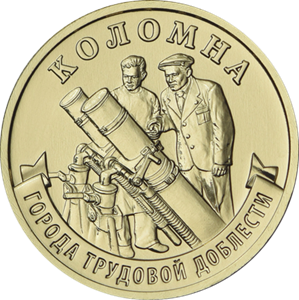
Obverse
the denomination of the coin ‘10 РУБЛЕЙ’ (10 RUBLES) with images of the number ‘10’ and the inscription ‘РУБ’ (RUB) hidden within the figure ‘0’ and alternately visible when the angle of view changes, stylised images of laurel and oak branches on the left and on the right, respectively, the inscription ‘БАНК РОССИИ’ (BANK OF RUSSIA) along the top rim, the year of issue ‘2026’ along the bottom rim, and the mint mark at the bottom right.
Reverse
a relief image of a fragment of the design of the City of Labour Valour stele and the inscriptions on the outer ring ‘КОЛОМНА’ (KOLOMNA) at the top and ‘ГОРОДА ТРУДОВОЙ ДОБЛЕСТИ’ (CITIES OF LABOUR VALOUR) at the bottom along the ribbon.
Authors
Designer: A.A. Brynza.
Sculptor: E.A. Tolzin.
Mint: Moscow Mint (ММД).
Edge: 6 sections with 5 corrugations and 6 sections with 7 corrugations alternated with 12 smooth sections.
Discover more
Kolomna was awarded the honorary title City of Labour Valour for the great contribution of its residents to the Victory in the Great Patriotic War of 1941–1945, uninterrupted manufacture of military and civilian products at industrial enterprises and people’s labour heroism and commitment.
The Kolomna machine-building plant began producing mobile platforms for anti-aircraft guns and hulls for light T-60 tanks, as well as four armoured trains. In the autumn of 1941, when Nazi forces approached Moscow, the plant began producing tank turrets that were used as permanent fire positions along a 132-kilometer defensive line. The plant also assembled mines, aerial bombs, hand grenades and other munitions, and also mortars, tractors, and motorcycles. At the end of 1941, the plant was evacuated to Kirov. The remaining equipment was used by Kolomna workers to repair damaged tanks and other military vehicles.
The Research and Testing range for small arms and mortars became a site for the development and testing of new weapons. Specifically, the Degtyarev and Simonov anti-tank rifles, the Sudaev submachine gun, as well mortars and heavy artillery were developed and tested there. In addition, specialists created universal cannons, mortars and bomb launchers for naval vessels. In 1943, the Research and Testing range was awarded the Order of the Red Star.
Almost 80% of all mortar types used in combat operations were designed by the Kolomna Special Design Bureau. In total, 21 designers and engineers from Kolomna received the Stalin Prize for the development and putting into production new military equipment during the war.
To ensure protection against enemy tanks, the city workers manufactured over 2,200 anti-tank hedgehogs, 500 tank turrets used as permanent fire positions and dug 12 kilometres of anti-tank ditches. As many as 5,000 workers from Kolomna and nearby villages were awarded orders and medals for the construction of defensive facilities and fulfilment of government tasks related to the defence of Moscow.
Sources: https://may9.ru, Executive Order of the President of the Russian Federation No. 304, dated 20 May 2021, ‘On Awarding the Honorary Title of the Russian Federation City of Labour Valour’.