
Snow Leopard

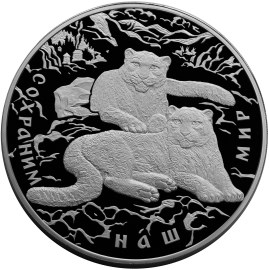
Obverse
in the center - the Emblem of the Bank of Russia (the two-headed eagle designed by I.Bilibin, lower - the semicircular inscription - "БАНК РОССИИ" (BANK OF RUSSIA) framed by a circle of dots and inscriptions along the rim: at the top - "СТО РУБЛЕЙ" (HUNDRED RUBLES), at the bottom - the date "2000", the letters to the left indicate the metal sign and the fineness, to the right - the fine metal content and the mint trade mark.
Reverse
: two snow leopards among rocks, in the background to the left - a village, trees, rocks, to the right - two mountain goats, in the horizon - outlines of mountains. The inscription along the rim - "СОХРАНИМ НАШ МИР" (PROTECT OUR WORLD).
Authors
The artist: A.V. Baklanov
The sculptor: A.A.Dolgopolova
St. Petersburg Mint (CПМД)
The edge: 360 corrugations
Discover more
The snow leopard, also known as the ounce, is a predator of the family Felidae, native to the mountains of Central and South Asia. Currently, it is the only representative of this family living mainly in cold environments. Among the large cats, it is the only one inhabiting high mountains.
The snow leopard is an exclusively Asian species. Its range in Central and South Asia covers the territories of Afghanistan, Bhutan, China, India, Kazakhstan, Kyrgyzstan, Mongolia, Myanmar, Nepal, Pakistan, Tajikistan, and Uzbekistan. A small part of the snow leopard’s habitat is in Russia – in the mountains of Southern Siberia. This represents about 2–3% of its global range, being the north-western and northern periphery of its habitat. In the Russian Federation, the total area of the snow leopard’s potential habitat is at least 60,000 square kilometres. The ounce is found in the Krasnoyarsk Territory as well as in the Republics of Khakassia, Tyva, Altai, and Buryatia.
The animal has a long and flexible body, a relatively small head, and a very long tail. The snow leopard’s body length, including the tail, ranges from 200 to 230 centimetres, and its weight may reach 55 kilograms. The ounce has a whitish to grey fur with dark rosettes and spots. The snow leopard’s diet mainly consists of ibex and mountain sheep and, depending on the migration of these ungulates, the predator moves along mountain slopes, from highlands to coniferous forests. Snow leopards are crepuscular animals, which are active primarily in the evening and at night. During the daytime, they rest and sleep on cliffs, often making dens in caves and mountain crevices. These are territorial predators leading a solitary way a life. Family groups are formed by females raising their cubs for two years after their birth. Inside its range, the snow leopard is at the top of the food chain and, therefore, faces almost no competition for prey. However, it is highly dependent on ungulate populations and whenever its food base decreases, it is forced to migrate to other territories. In the wild, snow leopards live for 10–13 years. In zoos and reintroduction centres, they can live for more than two decades.
The global population of snow leopards is gradually declining. The snow leopard is listed on the IUCN Red List, the Russian Red Data Book, and Appendix I to the CITES Convention, which prohibits trade in endangered species. The hunting of the snow leopard is also prohibited in all the countries of its range. One of the main reasons for the decline in its population is poaching. The species is also threatened by the depletion of the ungulate population, constituting its prey base. Furthermore, predators forced to attack livestock for the above reason are sometimes shot by local residents. Another problem is the reducing habitat of the snow leopard due to infrastructure development and climate change.
Source: http://nature.kremlin.ru