
The 50th Anniversary of the Soft Landing of Descent Modules on Venus and the Acquisition of Panoramic Images of the Surface of Venus

Obverse
a relief image of the National Coat of Arms of the Russian Federation, above it along the rim the inscription in a semicircle ‘РОССИЙСКАЯ ФЕДЕРАЦИЯ’ (RUSSIAN FEDERATION) framed with paired diamonds on both sides, under the coat of arms are the chemical symbol and fineness of the metal on the left and fine metal content and the mint mark on the right, at the bottom centre in three lines are the inscription ‘БАНК РОССИИ’ (BANK OF RUSSIA), the coin denomination ‘3 РУБЛЯ’ (3 RUBLES), and the year of issue ‘2025 г.’ (2025).
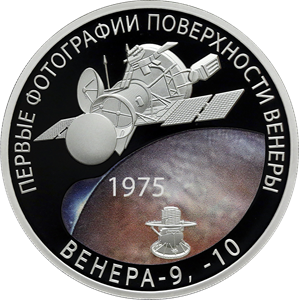
Reverse
relief images of the space probe Venera 9 and its descent module against the background of a coloured image of Venus as well as the inscriptions ‘ПЕРВЫЕ ФОТОГРАФИИ ПОВЕРХНОСТИ ВЕНЕРЫ’ (FIRST IMAGES OF THE SURFACE OF VENUS) and ‘ВЕНЕРА-9, -10’ (VENERA 9, 10) around the circumference as well as ‘1975’ in the centre.
Authors
Designers: E.V. Kramskaya (obverse), A.A. Dolgopolova (reverse).
Sculptors: A.A. Dolgopolova (obverse), computer simulation (reverse).
Mint: Saint Petersburg Mint (СПМД).
Edge: 300 corrugations.
Discover more
On 22 October 1975, the space probe Venera 9 soft-landed on the surface of Venus, and on 25 October 1975, Venera 10 also touched down on this planet. Both missions made numerous pictures of Venus. These were the first ever panoramic pictures of the surface of the second planet that is considered Earth’s ‘sister’ in mass and size. The missions significantly changed the scientific conceptions of Venus prevailing at that time.
First, the space probes, consisting of an orbiter and a descent module each, entered Venus’ orbit, and then their descent modules separated from the orbiters. By so doing, the orbiters remained on the trajectories that allowed them to fly over the landing site when transmitting data. The synchronisation of the module’s descent, the orbiter’s overfly, and the transmission, reception, and retransmission of radio signals to Earth were extremely difficult technical tasks being performed in deep space for the first time.
One of the most interesting technical solutions first used by Venera 9 and Venera 10 was the optical-mechanical scanner that allowed humans to see the surface of the ‘second planet’ in detail for the first time.
The space probes’ scientific equipment made it possible to conduct multiple remote and contact studies en route to Venus, in Venus’ orbit, and on the planet’s surface.
Source: https://www.roscosmos.ru.