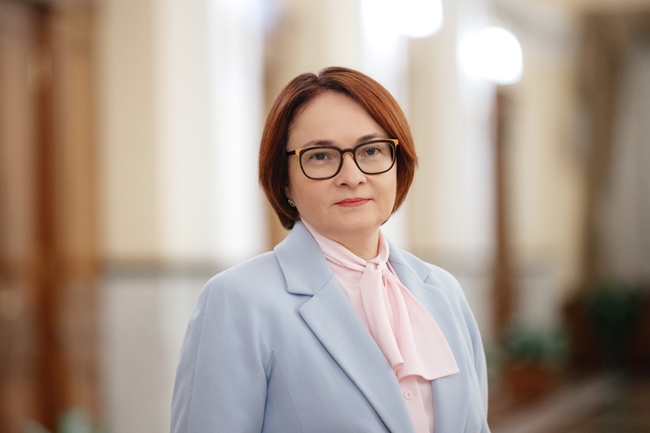
Elvira Nabiullina’s statement at meeting on bank lending to economy chaired by President Putin
Banking is not in the first circle of the most affected industries. Today, banks are rather the line of defence of our economy against shocks. The resources and safety cushion accumulated in the banking system should be used in a reasonable way in order to help the economy to get through the pandemic period and overcome hardships in global markets.
Indeed, banks have achieved quite a good standing and earned sufficient capital and liquidity by the moment of today’s challenging situation. They are well prepared and capable to accept a rather large amount of losses and grant loan repayment holidays, while continuing lending.
According to our assessments, the capital cushion currently approximates 5 trillion rubles. As to liquidity, the banking sector now has a surplus of nearly 2 trillion rubles. Moreover, banks have almost 8 trillion rubles of funds in hand, so to say, which is available security they may always use to raise money, whether in the market or from the Bank of Russia. Therefore, even today banks have capabilities both to restructure loans and continue lending.
Together with the Government, we are monitoring the progress of loan restructuring on an ongoing basis. I would like to emphasise that the scale of this restructuring is really unprecedented. Over less than a month after the launch of the programme, banks have received more loan restructuring applications than totally in the course of last year. For instance, restructuring requests submitted to 16 banks numbered 554,000 as of 15 April, while only over this week systemically important banks have received another 230,000 applications. What does this mean? This means that banks should definitely adjust their business processes in order to promptly consider all these requests and make decisions thereon. We are observing positive changes since the numbers of considered applications and approvals have been growing. We also expect that banks will soon be implementing the loan restructuring programmes at their full capacity.
In addition to the programmes entitling borrowers to restructure loans pursuant to law, banks are also implementing their in-house restructuring programmes for their clients. And the latter are also sufficiently large-scale. Overall, our data on the 11 systemically important credit institutions show that the percentage of approvals has increased to nearly 60% of the number of requests considered. This figure was about 44% last week, and approximately 14% two weeks ago. This is an upward trend, but there is certainly potential for growth. This is as regards individuals. Speaking of small and medium-sized enterprises, the percentage of approvals has also been rising, and it is slightly higher, approximating 80%, according to our information on the systemically important banks. A week ago, this figure was about 60%.
As to the results of our monitoring of the restructuring programmes, the progress of the 1/3-1/3-1/3 programme is really weak, and this is quite frustrating. In this regard, I absolutely agree with Mr Andrey Belousov and his opinion on the reasons why this programme is failing to gain traction. We need joint efforts to enhance it so as to make this instrument efficient and encourage banks to employ it.
Summing up the information on SMEs, I would like to remind you that we have also launched a new programme for preferential lending to banks with a limit of 500 billion rubles, which provides for the interest rate that is 1/3 below the key rate and is intended for banks maintaining SME lending volumes. By the moment, 19 banks have joined this programme and have already started to take out these loans. However, it is open for a broader range of banks.
In addition, it is becoming obvious that there is an increasing need to restructure loans extended to large businesses. Mr Belousov has already said this. We do need additional instruments to address this issue. Today, restructuring is an absolute priority in banks’ operation. However, banks should also continue their other functions, first and foremost lending, including remotely. It is essential for banks to maintain stability.
We have already introduced a sufficiently large package of regulatory relaxations helping banks to gradually adjust to the current situation, not to employ reserves immediately, and use the resources and buffers accumulated in ‘the good times’. This enables banks to implement their own restructuring programmes. I would like to stress that the regulatory easing does not involve risks to the interests of any bank clients, and makes it possible for banks to allocate more capital for restructuring and lending and spread over time their losses from decreased earnings and the incapability of a portion of clients to fully restore their operations. Thus, banks may now restructure loans through their in-house programmes for those borrowers who are not eligible even according to law, without any extra load on banks’ capital or additional reserves. Specifically, we have introduced such regulatory relaxations in relation to banks’ own loan restructuring programmes for individuals facing a decline in incomes and for the entire SME loan portfolio, that is, not only to the most affected industries. In other words, this covers nearly 5 trillion rubles of the loan portfolio.
As to loans to large enterprises, the regulatory easing is applicable to all businesses of the most affected industries, as well as to companies operating in other sectors—virtually to any companies whose credit quality was assessed as good as of 1 March. These regulatory relaxations actually encompass 28 trillion rubles of the loan portfolio, which is approximately 83% of the loans granted to large businesses. We have also allowed banks not to revaluate assets and collateral due to fluctuations recently observed in the foreign exchange market, equity market and bond market. Banks may use the appraisals as of 1 March. We are continuously monitoring the situation together with the Government and are ready to promptly introduce appropriate measures, including regulatory ones, that may be needed in the current situation.
Wrapping up, I would like to emphasise that I completely support Mr Belousov’s view that banks do have accumulated resources at their disposal. However, this safety cushion is not unlimited. Therefore, it is critical to act jointly with the Government in order to provide assistance first of all to individual and corporate borrowers, and to implement guarantee mechanisms that would support and not disrupt banks’ financial stability. This is extremely important. Another issue is that more banks should be entitled to join these programmes. We are aware that it is more convenient to first cover large banks since they have more branches and embrace more regions and clients. Nonetheless, it is essential that these programmes in the banking sector ensure equal competitive conditions. This will also expand the coverage of bank clients because both individuals and businesses receive services not only from majors, but also from small regional banks. Therefore, we believe that the range of banks eligible to join these programmes will need to be expanded. The Bank of Russia and the Government are taking joint efforts to tackle this task.
Thank you very much.
Full transcript of the meeting