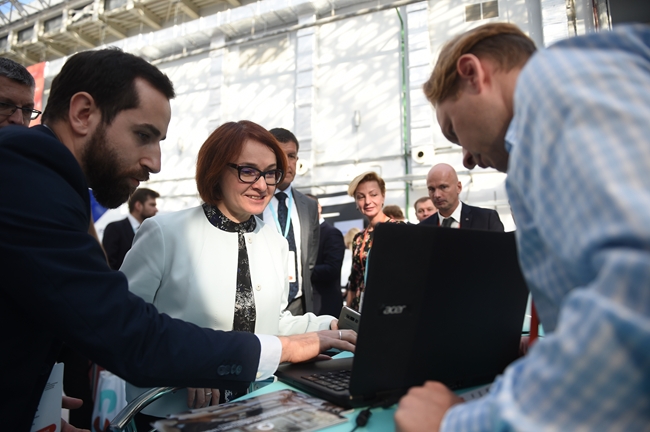
Finopolis–2017 participants discuss finance of the future and the prospects for new technology
Day One of Finopolis–2017 opened with a presentation by Brett King, the famous futurist and author of ‘Banks 4.0 – Banking Everywhere, but not at a bank’. He predicts that there will be no need for banks in the near future: ‘Branches will be replaced by big data experts capable of modelling human behaviour and understanding people's reactions and needs’, the speaker said.
Continuing with the topic, the plenary session attendants had a discussion about which new technology-based financial services are set to be the most sought-after. BoR Governor Elvira Nabiullina, who moderated the discussion, spoke of the need for new banking business models based on digital technology. According to Elvira Nabiullina, it is essential that the state take the lead in creating the infrastructure for new digital finance, which is set to reduce the costs faced by newcomers to the financial services market. ‘At the same time, we are aware that a lot of companies, mainly in the financial sector, possess ample resources to create such infrastructure on their own. ‘I believe, it will take less time for them to deliver if they act on a market basis than if the regulator took it upon itself’, she said.
Russian and foreign experts, in turn, looked into the cost implications of digital transformation when they were discussing key technological trends in the second plenary session. They spoke about which fintech forecasts for 2016-2017 failed and why.
The Forum activities were structured into sections and roundtables. The discussions were centred, among other things, on the Internet of Things and how it can change the world and, in particular, how mobile commerce will affect consumer behaviour and how the safety of 24/7 connectivity can be ensured. Other central discussion topics included statistical reporting in the digital age and new business opportunities in fintech. The discussion in the section was moderated by First Deputy BoR Governor Olga Skorobogatova, who invited the participants to deliberate the digital financial ecosystem's infrastructure: specifically, remote identification alongside the prospects for a potential single biometric system. ‘We believe, the voice and face are just the beginning. We intend to incorporate them into a holistic biometric platform. ‘As it progresses, the platform will gain new identification methods, such as iris-scanning. This is because reliable identification is only achieved when two to three dimensions are compared’, Olga Skorobogatova explained.