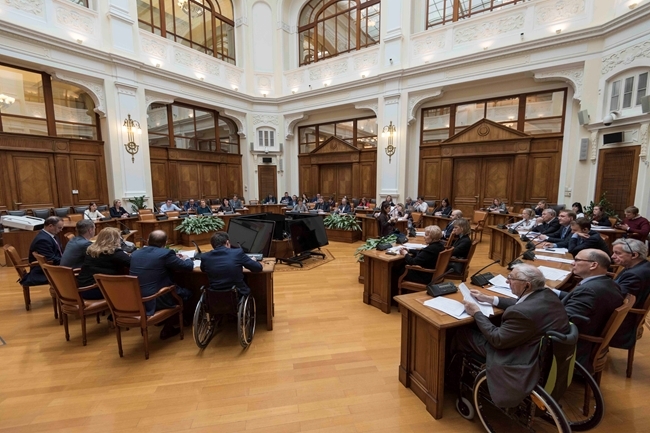
Regulator’s plan to set up a barrier-free financial environment in Russia approved
The Bank of Russia will offer a special training course for executives and top-managers at financial institutions. It will address modern approaches to understand disability and describe barriers hampering the access to core financial services for persons with disabilities (PWDs) and low mobility persons (LMPs). In the near term, work will be completed to adapt the Bank of Russia website so as to make it accessible to people with impaired eye-sight. These and other measures make up the regulator’s special plan for 2017. The plan was presented on 14 April 2017 during the meeting of the Bank of Russia working group on the financial inclusion of PWDs, the elderly and low mobility persons (LMPs).
The meeting participants approved the road map drafted with the involvement of representatives from financial institutions, public organisations and PWD associations. The document sets forth that in 2017 the Bank of Russia shall look into the current legislation to identify areas of excessive regulation in the financial sphere, which are having a negatively impact on the financial inclusion of PWDs and LMPs. Based on the findings of this exercise, discussions will be held to study the ways to adjust regulations and the advisability of expanding the Bank of Russia’s mandate in order to implement controls over the compliance with the respective legislation by financial institutions.
The road map also provides for the need to create a barrier-free environment for all categories of the population and for all sectors in the financial market while formulating requirements for core consumer protection standards and jointly preparing standards with self-regulatory organisations of the financial market. Credit institutions, in turn, will be advised how to draft internal administrative rules, and job descriptions for the phased introduction of accessibility to facilities and services for PWDs and LMPs.
The road map places particular emphasis on innovative solutions and IT projects designed to overcome existing barriers preventing the use of financial products and services by PWDs. For example, arrangements with NPCS have been reached to set up a pilot project to manufacture and introduce devices for various form factors using Mir payment system technologies, such as wristbands with in-built contactless microprocessors designed to effect payments for goods, works, and services. They may be used instead of conventional plastic card. These new facilities will offer a more convenient and safe method of payment to the blind and visually impaired, and to persons with upper limb movement disorders (or persons with absent upper limbs). In turn, credit institutions have been requested to develop applications providing remote access to financial services (online banking, mobile banking, and automatic services offered by call centres) in view of their potential use by PWDs.
Several road map measures are scheduled for 2018, including a detailed study of the legal implications of targeted lending for PWDs for the acquisition of rehabilitation equipment using a special electronic certificate. To do this, credit institutions may need access to the federal register of PWDs to confirm the existence of long-term, substantial disability. The Bank of Russia is carefully discussing these and several other issues with the Russian Ministry of Labour and Social Protection, which is to coordinate the road map prior to its final approval by the regulator.
As communicated by the head of the working group Mikhail Mamuta, head of the Service for Consumer Protection and Financial Inclusion, the Bank of Russia is going to elaborate several key performance indicators to assess the results of the planned efforts. “In this way, we will be able to monitor the effectiveness of the implementation of the road map and the advancement in financial inclusion for PWDs, and introduce adjustments, if need be”, he explained.